
The impacts of nonnegative doctor portrayals on public evaluations and professional attractiveness in medicine
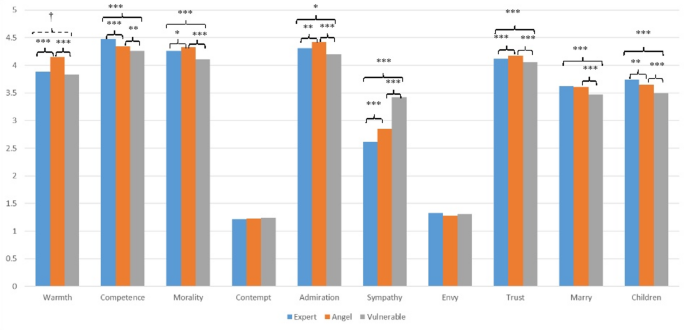
Study 1 was conducted from November 5 to 15, 2020 after receiving approval from the Ethics Subcommittee of Institute of Psychology, Chinese Academy of Sciences (approval no. H19050, issued 26 October 2019). The study was conducted in accordance with the principles of the Declaration of Helsinki, all participants provided written informed consent before any study procedures began. They received a concise description of the study’s aims, were assured that their responses would remain anonymous and would be used exclusively for scientific purposes, and were explicitly reminded that they could withdraw at any time without penalty.
Presurvey
By reference to the definitions of four types of common nonnegative doctor portrayals and the summary of relevant typical reports produced by Wei and Chen6 and An9we compiled the materials that we used to manipulate doctor media portrayals and conducted a preexperiment. The contents of the “experts” portrayal focused on the deeds of famous domestic science popularization platforms and relevant experts. The contents concerning the “angels in white” portrayal pertained to the advanced deeds of doctors who won the “China Physician’s Day” award. The contents associated with the “white-coated warriors” portrayal covered various touching deeds on the part of medical personnel on the frontlines of epidemic prevention. The contents related to the “vulnerable” portrayal included a survey report that described the current situation faced by doctors, which involves high levels of work intensity, low incomes, and tense doctor–patient relationships. The material associated with each portrayal contained an introduction to the overall situation of the corresponding content and a description of typical cases; this approach is in line with actual news reports, which tend to focus on typical characters in an effort to reflect group phenomena and combine individual portrayals with group portrayals. The materials are available in Appendix 1. For privacy protection purposes, the images used in the portrayals of the expert, angel, and vulnerable doctor conditions have been replaced with researcher-designed posters from Study 2 that contain no identifiable facial features. The accompanying text content remained consistent across both studies.
A convenience sampling approach was used to recruit a total of 64 individuals (18 males) via the WeChat group used in the presurvey; the average age of participants was 25 years (SD = 8.92). These participants were asked to read 4 news items, which were presented in random order, and to select the doctor portrayal shaped by the news. Moreover, the participants were required to write down the surname of the doctor who was described in detail in the news as a seriousness check. Ultimately, 55 questionnaires were retained. Statistical information revealed that the successful shaping ratio for the “expert” and “warrior” portrayals was 100%, the corresponding ratio for the “vulnerable” portrayal was 94.5%, and the ratio for the “angel” portrayal was 92.7%. Thus, the manipulation of the four types of doctor media portrayals via these experimental materials was successful.
Formal survey
The formal study featured a single-factor, between-participants design, and a control group was included in addition to the 4 experimental groups. In the control group, participants read a short, emotionally neutral news-style story that described an ordinary person who had lost their backpack on a Tuesday afternoon. The passage concluded with a practical reminder that encouraged readers to take care of their personal belongings in public places. This material was entirely unrelated to doctors or healthcare and was carefully matched with the experimental texts in terms of length and formatting.
The required sample size was estimated with the assistance of G*Power 3.1 software22; the main effect was set to achieve 80% test power, and the effect size was set to 0.25. The results revealed that the total sample size needed was 200. Ultimately, a convenience sampling approach was used to collect 216 questionnaires via Questionnaire Star (www.wjx.cn, an online survey platform in China); a total of 39 participants were included in the control group, 42 in the expert group, 47 in the angel group, 42 in the warrior group, and 46 in the vulnerable group. The average age of the participants was 34.67 years (SD = 7.05), and the sample included 88 males. First, the corresponding materials were presented to each group of participants. They were asked to describe the character portrayed in the news in two words as a manipulation check. Subsequently, the participants’ stereotypes of doctors and other research variables were measured. Finally, various demographic variables, including gender, age, education, annual income, and physical health status, were measured as control variables.
Measurement tools
All scales used in this study were scored on a 5-point Likert scale, in which context 1 indicated complete disagreement and 5 indicated complete agreement (See Appendix 2).
Stereotype content scale
The stereotype content model questionnaire developed by Guan and Cheng23 was used in this research. The instructions provided were as follows: “In your opinion, members of the doctor group are…” This scale included a total of 6 questions. The Cronbach’s α coefficient for this scale was 0.75.
Intergroup emotions
Four items drawn from Guan and Cheng23 were used to measure the intensity of the contempt, admiration, sympathy, and envy exhibited by the participants towards the doctor group with the aim of exploring the roles played by these four emotions separately. The question asked with regard to this instrument was as follows: “When you think about the doctor group, how strongly do you experience the following emotional reactions?” The participants responded to this question on a scale ranging from 1 (“not at all”) to 5 (“very strongly”).
Trust in doctors
This research relied on Deng’s24 single-dimensional patient trust scale, although some items were deleted, and two items that were newly developed for this research were added, i.e., “Overall, I trust doctors” and “I can entrust my life to doctors without hesitation”; the scale included a total of 6 items. The Cronbach’s α coefficient for this scale in this study was 0.85.
Willingness to marry a doctor
A single item was used to measure this factor: “Are you willing to marry a doctor?”
Willingness to allow children to become doctors
A single item was used to measure this factor: “Would you like your child to study medicine in the future?”
Results of the survey
All analyses were conducted using SPSS 22.0. We conducted two-tailed Pearson correlation analyses to examine the relationships among key variables (see Appendix 3 Table S1). The correlation coefficient between the warmth and morality dimensions was only 0.58, thus verifying the hypothesis concerning the separation of the warmth and morality dimensions. Notably, correlation analyses revealed that level of education was positively associated with admiration for doctors (r = .22, p = .001). In addition, self-reported physical health was positively correlated with trust (r = .18, p = .010).
To examine potential group-level differences among the conditions, a one-way analysis of variance (ANOVA) was conducted for each demographic variable. The results indicated that among all the variables measured in this context, only physical health status exhibited significant differences across the five groups, F(4, 211) = 2.56, p = .040. No significant differences were observed in age, gender, education, or income. Therefore, physical health status was included as a covariate in subsequent one-way ANOVAs to control for its potential influence on the outcome variables.
One-way ANOVAs controlling for physical health status were performed to test group differences (see Table 1). In terms of stereotypes regarding doctors, evaluations of doctors’ warmth and morality were highest in the warrior group and lowest in the vulnerable group. Significant differences were observed among the five groups in terms of their evaluations of the morality of doctors, p = .003, and marginally significant differences were observed in terms of competence evaluations, p = .076. Least significant difference (LSD) post hoc comparisons revealed that participants in the warrior and angel groups rated doctor morality significantly higher than did those in the vulnerable group (p ≤ .012). In terms of competence, participants in all three nonnegative portrayal groups (i.e., expert, angel, and warrior) rated doctors as significantly more competent than did participants in the control group (ps ≤ 0.019), whereas participants in the vulnerable group did not differ significantly from those in the control group.
In terms of participants’ emotions towards doctors, significant group differences were observed in both contempt (p = .018) and admiration (p = .024). Post hoc comparisons revealed that contempt was significantly lower among participants in the expert, angel, and warrior groups than among those in the control group (p ≤ .012), whereas the vulnerable group exhibited no significant differences in this regard. Admiration was significantly higher among participants in the warrior and angel groups than among those in the control group (p ≤ .043). No significant differences were observed in sympathy or envy among the five groups (ps > 0.05). However, descriptively, sympathy was highest in the vulnerable group and lowest in the expert group, whereas envy was highest in the expert group and lowest in the control group.
The differences among the five groups in trust in doctors, willingness to marry a doctor, and willingness to allow children to become doctors were not significant. However, the trust in doctors and willingness to marry a doctor reported by participants who read the news associated with the vulnerable portrayal were the lowest among the five groups, and the willingness to allow children to become doctors was also lower than that of participants in the control group. Moreover, trust in doctors, willingness to marry a doctor, and willingness to allow children to become doctors were the highest in the warrior group among all five groups.
Discussion
Study 1 revealed that nonnegative media portrayals of doctors have distinct effects on public perceptions. Both the warrior and the angel in white portrayals significantly enhanced evaluations of doctors’ warmth, competence, morality, admiration, and trust while reducing contempt in comparison with the control group. The warrior portrayal consistently received the highest scores, including in terms of professional attractiveness, thus suggesting its broad and strong positive impact.
The expert portrayal mainly improved competence and reduced contempt, but it had weaker emotional and relational effects. These findings are in line with research that has reported that competence alone may not elicit admiration unless it is paired with warmth or morality12. In contrast, the vulnerable portrayal increased sympathy but was associated with lower scores on most other dimensions, thus indicating the potential risk of overemphasizing hardship in media narratives.
One limitation of Study 1 is the use of a convenience sample, which may affect the generalizability of the findings. The sample was relatively small and skewed toward younger and female participants, reflecting the demographic profile of online survey respondents in China. Moreover, the single-factor, between-participants design used in this study offers a degree of internal validity by isolating the effects of each portrayal. However, the question of whether these effects persist when individuals are exposed to multiple portrayals, as is common in real-world media environments, remains unanswered. A within-participants design, in which the same participants are presented with different framings, could simulate natural exposure conditions more accurately and provide a more nuanced understanding of comparative and sequential effects in this context.
link