Med School or Ironman? These Pro Triathlon Docs Know.
Updated January 27, 2026 07:06AM
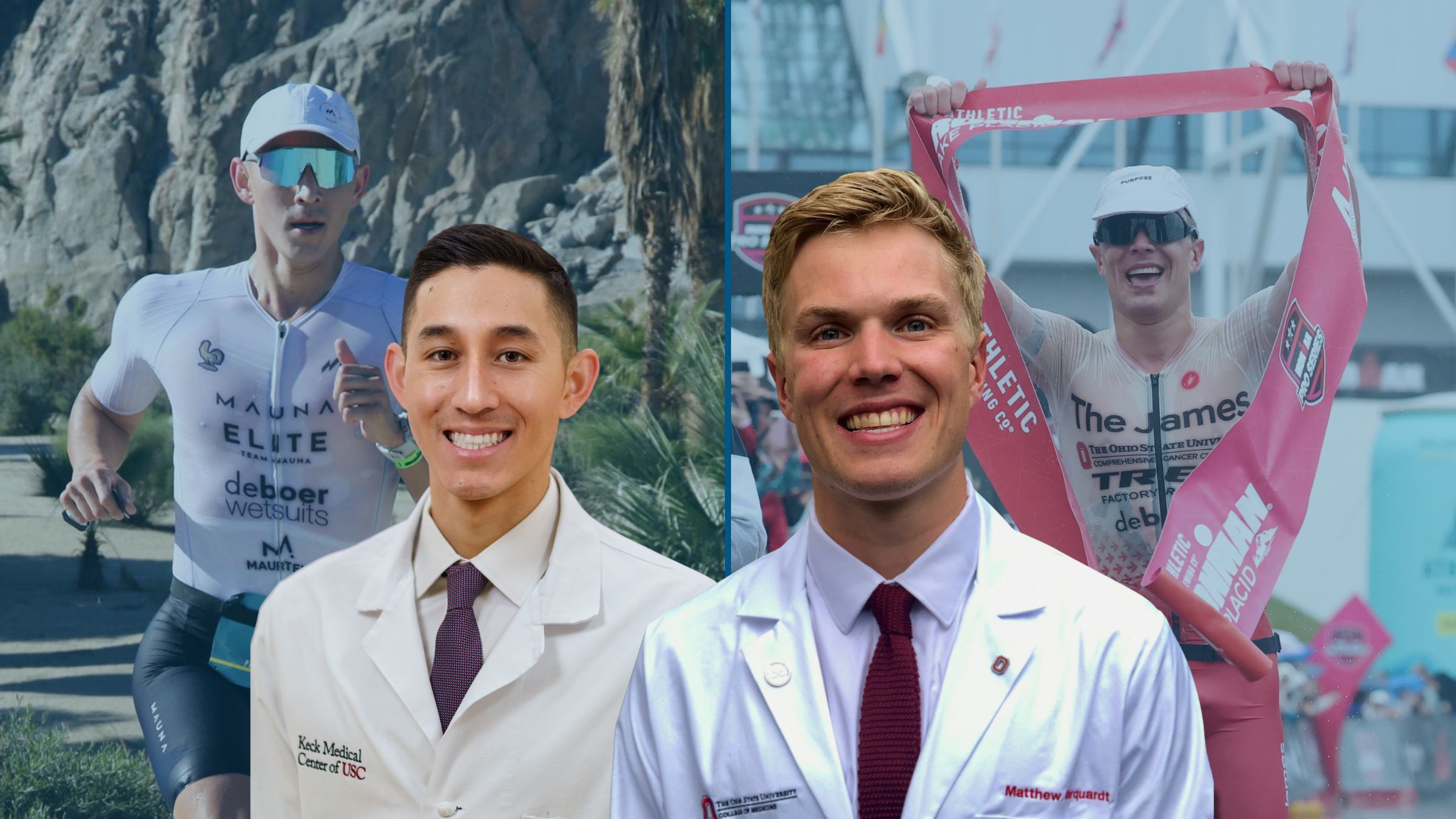
For many triathletes, carving out the time to train for three disciplines is a challenge. For Matthew Marquardt and Cory Mayfield, add to the equation the rigors of working in medicine. But these two excel in both arenas.
They have found many ways in which their work in medicine has actually made them better athletes, and vice versa – their training for triathlon has made them better in their careers.
Mayfield, a last year resident at USC in orthopedic surgery, won his age group at the Ironman World Championship in Nice last year. He decided to get his pro card for an abbreviated 2026 season before he begins his fellowship at Midwest Orthopaedics at Rush in Chicago this summer.
Marquardt, the 2025 Ironman Lake Placid and Ironman Cairns champion, is in his third year of medical school at The Ohio State University. He has an interest in head and neck cancer surgery.
We recently sat down and chatted with them ahead of their 2026 season.
Triathlete: How do medicine and triathlon training complement each other?
Mayfield: Medicine and triathlon teach you to prioritize and balance things out. You are going to have a thousand different things pulling you in different directions. It is about balance and getting through difficult things. Triathlon is the same.
Marquardt: A big pillar for why I switched into medicine was the performance aspect of it. In business, you have to perform once a month or once a quarter. In medicine, you have to perform every single day. That applies with training for triathlon too.
What does a typical day look like? How do you fit it all in?
Mayfield: It has been a moving target over the last five years. The early years in residency were much tougher because of the amount of [being on] call, and time is not your own. My coach and I have been good about being deliberate when I am going to be busy. And when I have times that are less busy, we can get out and get after it. My training volume is variable – it can be as low as 10 hours and my biggest weeks are usually right over 20 hours.
I have gotten used to less and less sleep as time has gone on. It is highly variable but usually ranges between 5-6 hours on a regular night, and a good night of sleep is anything over six hours. I often get out the door by 4 a.m., and it is a freeing time because no one bothers you at that time of day. I work out in the dark, and I am not stressed out the rest of the day while in surgery.
We don’t work “shifts.” A typical day for us usually involves rounding on inpatient consults and post-op patients starting somewhere between 5:30 and 6 a.m., depending on what needs to be done that morning. We then either do clinic or operate. Clinic usually has a regular end time of about 4-5 p.m. OR [operating room] time is highly variable – it can be as early as 4 p.m. or on longer days well into the evening, even rarely the next morning. I typically adjust to put double workout days when I know I’ll get out at a reasonable hour. On days when I expect it to be a long day, then I do a single workout early in the morning (about one hour). On some rotations, we take in-house trauma calls at Los Angeles General Medical Center, which usually lasts about 26 hours, and then we have the day after off to sleep (“post-call”). Overall, work hours as a resident are highly variable depending on clinical schedules and other academic responsibilities, but it typically hovers around 70-80 hours per week at the hospital, and this does not include time spent studying or preparing for cases outside of work.
Marquardt: I have a mentality that there is no such thing as not having enough time; it is just having mismatched priorities. Life is about how you order your priorities. Communication with a coach has been crucial in setting expectations. Load management is super critical because the recovery objectively less than ideal. You have to make sure you are not overdoing it because the margin for error is smaller.
Most mornings I have a 20-40-minute window between finishing my workout and needing to be out the door heading to the hospital. All of that time is spent showering, getting dressed, and packing up for the day. Thankfully, pre-rounding is sitting down, but rounds can be 3-4 hours without sitting down, or access to food or water. I try to mitigate the effects of this by wearing compression socks every day and ensuring that I am well-hydrated before rounds. I will often apply a “hyper hydration approach” where I drink an electrolyte drink with extra sodium to help my body hold onto the fluids a bit longer than it would otherwise.
In my opinion, recovery starts with the workout. If you don’t have good training load management that is tailored to your situation, then no amount of special recovery technique will be able to help you recover. Having a coach is one of the most important aspects of my life because he handles the load management and ensures that I am able to absorb the stimulus. Nutrition is another key aspect of recovery that often gets neglected. I might “only have” a protein shake and some bread with honey or jam, but in reality it is tailored to provide the correct number of calories and right distribution of macronutrients (i.e., high carb, moderate protein, low fat) to help my body most effectively recover from the workout. I pack all of my meals to ensure that I have time to eat during the day and then make sure that I am eating the right distribution of macronutrients to optimize performance. The hard truth that most triathletes might not want to hear is that if you don’t handle the big things right (training load management, sleep, nutrition), then the gadgets don’t help at all.
I am constantly adjusting expectations and focusing on what I can control versus what I can’t. You can go home and freak out or you can say, “I am going to make the most of what I have and do the best I can.”
How do people react when you tell them you are a triathlete?
Mayfield: Most of the reactions come from staff at the hospital, and they are more shocked that I can manage to do both because they know how much we work. People are shocked that you can balance both. It really just comes down to when you prioritize things. It is not prohibitive to your life that you can do them both at a fairly high level.
Marquardt: I started triathlon when I started medical school, so I thought it wasn’t possible to get where I have while in school. I proved myself wrong, which has been fun and cool. People either know who I am or they have no idea, and I try to keep it pretty low key and don’t bring it up very much.
How have you become more efficient in your daily process?
Mayfield: I don’t really believe in multitasking. I feel like you can study on the bike trainer but it is not an effective use of time. I believe you should pick one thing and do it. It isn’t about multitasking, more about being diligent about the time blocks you have.
Marquardt: I actually try to multitask as little as possible. All the research shows that you can’t truly multitask, and quality goes down when you do. There are times when I study and train but I try to keep that to a minimum. I focus on finding those two, three, or four minutes in the day to get things done and take advantage of the small moments.
It certainly will sound elitist, but it can be hard to describe how pressed for time one can be until they become a medical student/resident/physician. When you are taking care of patients you have to be 100% focused, not only because someone’s life is on the line, but also because there is so much information and messages (from nurses, surgical teams, etc.) coming at you that being distracted outside of the work at hand can lead to something important slipping through the gaps.
There are so many moments during the day where you can send a text or email or study that most people don’t realize. There is a remarkable amount of studying that one can do on a cellphone via flashcards and practice questions. This means I can do flashcards while walking into the hospital or riding up the elevator. I can also send a text or make a phone call while walking between two parts of the hospital, etc. Sometimes, I do send emails and study via a flashcard app called Anki while working out, but I try to separate triathlon from medicine as much as possible as a way to recharge.
Certainly I get caught scrolling on social media from time to time, but I try to produce content rather than consume it. Study after study has shown the negative impact of social media on concentration, mental health, etc., that I try to be involved with it as little as possible apart from what I do as part of my job as a triathlete. When I really need to get work done, the phone goes on silent and is put in a drawer out of sight.
How do you stay motivated?
Mayfield: It has to be intrinsic because I am not making a living doing this. I do this because it is fun and keeps me engaged and active. My motivation comes from using it as an outlet away from medicine. Medicine is brutal in its own way and grueling. Triathlon is something that keeps you away from it and improves your ability in med school and as a doctor.
Marquardt: At the end of the day, this sport is incredibly hard, and if your motivation is purely external, you are not going to last very long because it is way too hard. What draws me to medicine, draws me to triathlon too – the ability to improve every single day. That process of continual improvement is necessary for long-term success in the sport and medicine.
You probably don’t believe that I am working from 5 a.m. to 6:30 p.m., but it is the truth, I am doing something professional-focused during those hours almost every day – since triathlon for me is technically a job. What prevents burnout is that there are many different things that I do during a day (i.e., training, direct patient care, lectures, studying, etc.) and that I feel a very strong sense of purpose in everything that I do. The sense of purpose above everything else is probably one of my strongest protectors against burnout.
The biggest thing overall though is being very intentional with how you spend your time. Is every single second optimized in the pursuit of triathlon, research, and medical school? Absolutely not. Relationships are another key part of what I care about deeply and prioritize. This means that I often don’t get much work done after 6:30 p.m. because that time is spent on my partner. Also, are there times where I just walk outside to walk outside? Absolutely, it is important to disconnect and experience the world. But I do not find any value (intellectual, emotional, or entertainment) out of watching TV or scrolling on social media. There is one scenario, though, in which I enjoy watching TV, and that is when I watch it with my significant other. Since she is a medical resident and also has a very busy schedule, this amounts to less than one hour of TV total per week, if we are lucky.
Also finally, I would say that time is only wasted if it is spent without intention. My goal is to spend all of my time intentionally as it is a finite resource that can never be recovered once spent.
link