


All twenty-seven students invited wrote the reflective report (response rate 100%, 9 in each academic year), with 16 women (59%) and 11 men (41%).
Early clinical exposure in the LaP Dr. House course allowed students to gain insights into the daily work of physicians while building respect for patients and other members of the healthcare team. They started the process of developing their professional identity and learned how to deal with their emotions facing difficult situations, including death. Most effects were transmitted by senior physicians as role models, building the basis for students’ professional growth and development of professionalism. Some of the reflective writing reports surprised us with an unexpected depth of understanding of what it means to be a physician, thoughts that we would rather expect after years of practical experience in medicine.
Overall, we identified three themes with their respective categories of codes: (1) Professional growth, including formation of professional identity, dealing with emotions and experience with death; (2) Reinforcing motivation for further studies and work as a physician, including integration into medical studies, shaping a supporting environment and course as a highlight of the studies; and (3) Immersion into the medical field based on real-world exposure, including benefitting from early patient contact and exploration of the field of (internal) medicine. Throughout the reflective reports, role modelling appeared repeatedly as a driving element for the observed effects (Fig. 2). Finally, we discussed feasibility and the students’ suggestions for improvement.

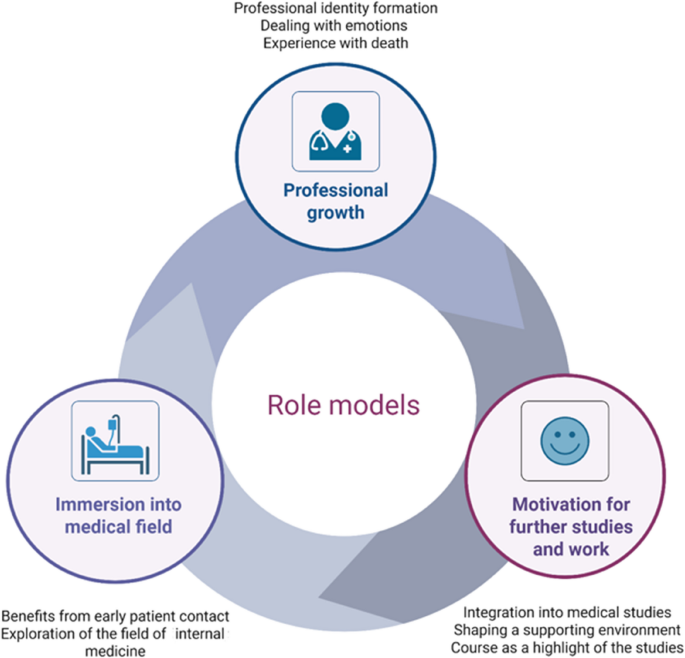
Themes and categories of codes summarizing the effects of the LaP Dr. House course on first-year medical students
Theme ‘professional growth’
‘Professional growth’ was the strongest and mainly represented theme, closely linked to and partially overlapping with the other two, and including the following categories of codes:
Category ‘Development of professional identity’
Almost three-quarters of the students discussed topics related to the formation of their professional identity. They ‘gained a perspective on the job and can imagine now how it is to work in the health system, how the various components of it cooperate and which roles a physician can perform’ (R21). The students could ‘imagine themselves as a physician’ (R27) and could recognize the professional symbolism of the white coat: ‘it was a very special but also a good feeling to go to patients in a white coat for the first time and ask them questions’ (R27).
The students also noticed an improvement in their self-confidence: ‘…the contact with patients took the fear away from me’ (R22); ‘At the beginning, I felt like thrown into cold water….in the end, contact with patients felt much more natural. This confidence was the most precious I took from this course’ (R26). ‘In the end, I approached the patients with more self-confidence, and when I meet a patient now, I no longer feel like an impostor because, thanks to the LaP Dr. House course, I can draw on a considerable wealth of experience, despite the short duration of my previous studies’ (R19).
Another critical issue was the building of a relationship with the patients and social competence: ‘I can imagine that developing a relationship with patients and accompanying them on the whole way could be something nice’ (R1); ‘At that moment I knew that there was a long way in front of me and that I must focus on developing my social competencies at least as much as on the theoretical aspects of the studies’ (R6).
Another student commented on the difficulty of maintaining distance from the patients’ moving fates: ‘Some of the life stories I faced were extremely touching – they showed me how difficult daily work of a physician can be: to find a distance to work after coming home’ (R3).
Repeatedly, the students praised the patient encounters under the guidance of a senior physician, where they could ‘learn how to take a medical history and how to examine abdomen, lungs and heart, and had to deal personally with the patients (R15). Some of the students ’did not have the skills to communicate naturally’; nevertheless, ‘this can be learned and built upon during the career’ (R15). Learning basics of medical history taking and physical examinations already in the first year was very motivating (R17). It was ‘strange to ask unfamiliar people intimate questions and to touch them’ but as it was natural for experienced physicians, R17 assumed ‘everyone can get used to it’. He also understood that he needed to ‘gain enormous knowledgem while motivating him to participate in the theoretical lectures”.
Three statements merit particular interest due to their complex insight into the medical profession dealing with meaning of medicine, meaning of life, basis of trust and non-negotiable respect (Fig. 3):


Shaping future physicians—insights from three first-year medical students after completing the Dr. House LaP course
Category ‘Dealing with emotions and experience with death’
Approximately one-third of the students spoke about distinctly positive emotional topics—compassion, trust, hope, courage, and respect. Some also described strong moments that felt negative or left them shaken – specifically, concerning their first experience with death or threat of it.
The students discussed learning to distance themselves from the fates of their patients: ‘there were sometimes very moving fates that touched me and have shown me how difficult it must be in daily life as a doctor to take care of yourself and to distance yourself from them after work’ (R19). They spoke of trust between physicians and the patients: how ‘amazing it was how quickly a relationship of trust developed within the protected framework of confidentiality and how openly the patients spoke about their illness and life history without directly benefiting from it’ (R16), as well as trust between the physicians and the students: I lost my inhibitions more and more because I noticed that both the patients and the senior physician placed much trust in me, even though I am ‘only’ a student’ (R19). The students also discussed the topic of giving hope to the patients: ‘…how good it feels to talk to patients who are on the mend and to know that the treating doctors can give people hope”(R19), giving courage to the students: ‘…these patient seminars demanded that I take courage early on…’ (R23) and that ‘the contact with the patients took away our fears/inhibitions and taught us how to treat the patient with respect’ (R24).
Some students might have been overwhelmed with their first experience with death. One respondent stated being surprised to come in contact with the body of a deceased patient so early in the studies: ‘It was special at first, but over time you got used to it’ (R17). Several students were strongly touched during an unexpected situation while witnessing a complication of an elective coronary angiography – a cardiac tamponade with a successful resuscitation: ‘It was very upsetting for me just to stand by while they were trying to save the patient’s life and not being able to do anything myself. I was very overwhelmed with the situation’(R3).
Theme ‘motivation for further studies and work’
Motivation for further studies and becoming a physician was a strong, repeatedly stated topic in approximately half of the reflective reports. Students gained a clearer understanding of what and why they should learn and felt more integrated into the medical student community.
Category ‘Integration into medical studies’
Through the course, the students were able to understand why they were studying and what is awaiting them: ‘The course gave me much motivation because it kept reminding me what I was studying for and in which disciplines you can deepen your knowledge as a doctor in internal medicine’ (R19); “The course was the most interesting part of this academic year for me. It gives an outlook on what we could expect professionally and thus an additional motivation to complete this long training’ (R16).
The cohort of students whose participation in the course coincided with the second year of the coronavirus pandemic benefitted the most from in-person contact, as at that time most of their lectures were online: ‘The course gave me the motivation for my studies in addition to all the online lectures and showed me once again that I am in the right place’ (R19).
Repeatedly, the motive of gaining skills early in the studies increased the motivation for further studies: ‘We learned our first manual skills, which was a real benefit in addition to the online lectures. … I often left the course events feeling confident; they always reminded me of where my studies could lead me’ (R19).
Often, the students praised the course as strongly motivating for further studying as opposed to the theoretical parts of the curriculum: “The LaP seminars were the highlight of my first bachelor’s degree. It was a way out of the serene theoretical lectures and a chance to experience the real world of medicine’ (R19).
The students acknowledged that they had very little knowledge at this stage. Nevertheless, they praised the timing of the course: ‘I am convinced that the first year is also the perfect time for LaP Dr. House lessons. Of course, I was technically overwhelmed, but the insights into the profession made me confident that I was in good hands studying medicine (R19).
Category ‘Shaping a supporting environment’
Several students praised their student peer tutors for helping them during the challenging first year of studies: ‘I found it very helpful to have senior students with me. They created a safe environment for us in which we could ask questions about our studies on a friendly level’ (R15); ‘We always had competent experts whom we could consult in case of difficulties and who were happy to help us. This gave security for the sometimes insecure everyday life in medical studies’ (R25). Many students appreciated the social aspects of the course, allowing them to gain friends and integrate better into their studies: ‘Social events that are fun and not only bring you joy but also a nice form of motivation for your studies based on shared experiences’ (R21).
Category ‘Course as a highlight of the studies’
For some students, the course in general and its components were the ‘highlight of their first year’ (R10 and R23). The students also specifically praised the online competition in clinical reasoning (R14), a night shift in the emergency room (R1), the seminars about medicine in developing countries (R19), or a visit to the operating room during cardiac surgery: ‘It was one of the most magical moments in my life thus far when I saw a beating heart for the first time. I still have this picture today clearly in my mind’s eye’ (R15).
Theme ‘immersion into the medical field’
Students appreciated the early exposure to real-life clinical medicine. Many codes were linked to meaningful experiences and insights gained during their initial interactions with patients and healthcare professionals in the unfamiliar setting of everyday clinical practice.
Category ‘Benefits from early patient contact’
The first contact with patients left a strong impression on the students. More than three-quarters of the students discussed this in their reports. They were impressed by the possibility of learning first medical skills: ‘I find it helpful to practice communication with patients in the first semester. It is so essential that you should learn it for a long time, and the best way to do that is to start early’ (R12); or ‘I think it is great that we were often able to apply what we had learned directly: medical history, listening to heart, breathing and intestinal noises with a stethoscope, lung percussion, ultrasound and taking blood. I would have liked to have practised these practical skills even more’ (R18). This category partially overlaps with development of professional identity as well as dealing with emotions (see above).
Category ‘Exploration of the field of internal medicine’
Approximately one-third of the students praised the possibility of exploring several areas of medicine and were thus able to start the selection process for their future careers: ‘The visits to the hospital with the various subject areas gave us a good insight into the opportunities we have after graduation and gave us a chance to find possible interests that we want to pursue in the future’ (R25). They acknowledged the broad spectrum of internal medicine: “Through the course, I was able to gather many different impressions of internal medicine. I particularly like the versatility and size of this area: you have to look at the patient from head to toe in order to make the right diagnosis’ (R17), as well as the exciting aspects of the field: “Internal medicine has action! So much that I can see myself in this field’ (R17), making it possible to imagine working in internal medicine in the future.
‘Role models’ as a connecting element
The category of ‘role models’ appeared throughout the reflective writing reports, acting as a connecting element between the three themes. The students mentioned senior physicians – as well as the student peer tutors – as role models, helping them understand what it means to be a physician, or seeing what one can learn along their way. They praised the possibility of discussing everyday issues like the compatibility of career and family: ‘I have always worried how will I be able – as a woman – to combine work with family in the future, imaging the shift work and overtime that awaits us. My concerns have eased somewhat over the year as I have seen many examples of how it can still work’ (R1); ‘It was encouraging to hear that our LaP doctors both have children and still work in the hospital as senior doctors’ (R4). The students were impressed to witness senior physicians in action, for example performing a resuscitation during a coronary angiography: ‘The precise and calm reaction of the medical personnel involved, in particular of the doctor, deeply impressed me’ (R4), or during typical general practitioner’s work: ‘I was extremely impressed with the vast knowledge of the family doctor and her ability to be on the same wavelength during communication with each patient’ (R4).
Also the student peer tutors (4th year of medical students) were seen as role models: ‘It was impressive to see how our student tutor was able to perform neurological examination’ (R7).
Feasibility and suggestions for improvement
We did not specifically elicit the students’ perspectives on the course’s feasibility and students did not address it by themselves; hence, we cannot present direct quotations on this issue. Nonetheless, their active participation, minimal absences, and overall satisfaction with the course suggest that it was feasible in this setting. The students also maintained close communication with their supervising physicians and coordinated session schedules in a mutually convenient manner, further supporting the viability of the course. Additionally, the course has consistently received high ratings in the faculty’s evaluation reports since its inception in 2016.
Concerning suggestions for improvement, some students raised wishes for even more teaching of clinical skills (R#18), conducting more contests in clinical reasoning (R#18) or using less professional language (R#11).
link